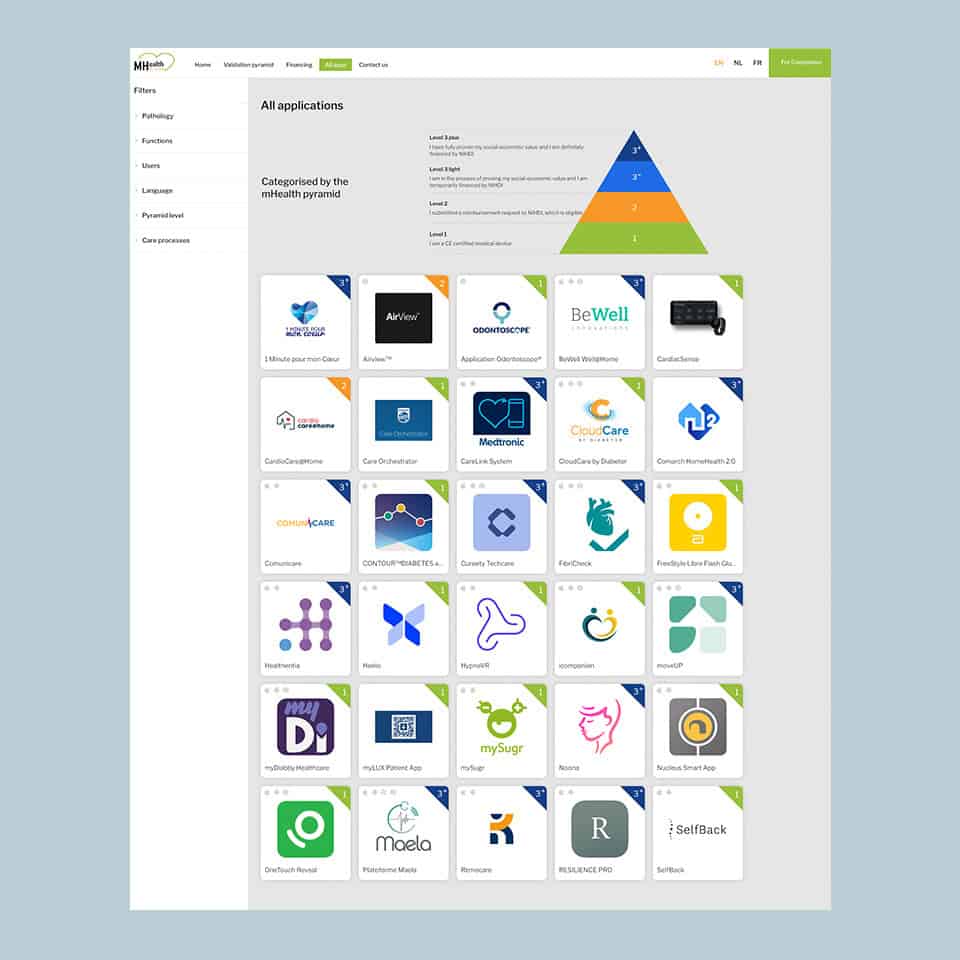
The mHealth Belgium website is the official Belgian platform that validates CE-marked mobile health apps and makes them comparable for healthcare professionals and patients. It is an institutionally based initiative: recognized, regulated, and aimed at an audience that demands a high level of reliability.
This creates a specific mission for the website: not to persuade in the traditional marketing sense, but rather to inform, clarify, and reinforce the trust that the platform already enjoys at the institutional level—and to convey that trust to healthcare professionals and patients visiting the site for the first time.
When your target audience expects reliability as a prerequisite
mHealth Belgium serves a target audience that is quick to lose interest when in doubt. Healthcare professionals who want to validate or compare an app expect a platform that is accurate, up-to-date, and clear. A vague description, an outdated page, or unclear navigation breeds mistrust in a context where mistrust is unwarranted.
That is the communication challenge facing institutional platforms: they must be accessible to a broad audience while also appearing authoritative to a critical professional audience. These two goals clash when the site is too technical for the average user or too superficial for the expert.
In addition, mHealth Belgium has multiple stakeholders: healthcare professionals looking for apps, developers who want to have their apps validated, and policymakers who consult the platform. Each group has different questions and is looking for different information.
A Clear Structure for a Complex Task
LOFT 33 built an informational website in Joomla for mHealth Belgium. The structure is organized around three key user profiles: the healthcare professional, the app developer, and the interested citizen or patient.
Each profile has a clear path through the site: what can I find here, how do I use the platform, what are the validation criteria, and how do I find a validated app. These paths aren’t compartmentalized into separate silos, but are woven into a navigation system that feels intuitive to every type of visitor.
The tone of the texts is clear and direct: no unnecessary legal language, no academic jargon where plain language will suffice. That is a deliberate choice. A platform that aims to reach citizens and patients should not be written like a policy document.
The technical information for developers is organized in layers: a concise overview for those who want a quick understanding of how the validation process works, and more in-depth documentation for those who need the details. Both layers are accessible without the visitor having to go through the other layer.
What This Project Illustrates About Websites for Institutional Platforms
Institutional websites often fail in one of two ways: they are too formal and lose the general public, or they are too informal and lose the authority they need. Striking the right balance requires a deliberate approach to tone, structure, and the layering of information.
mHealth Belgium is a project in which LOFT 33 struck that balance for a platform with a specific social role. The website is the face of a system that helps healthcare professionals and patients find reliable digital health tools. That calls for a site that exudes reliability, from the first page to the last technical specification sheet.
Do you have an institutional platform, an industry organization, or a government-related initiative that needs a strong digital presence? Schedule a meeting with LOFT 33. You can read more about our approach to complex information platforms on the “Custom Websites and Platforms” page.
Frequently Asked Questions About Websites for Institutional Digital Platforms
Institutional websites must serve multiple target audiences: experts, policymakers, and ordinary citizens. The challenge is to find a structure and tone that works for each audience without fragmenting the content into separate worlds for each target group. This requires a well-thought-out information architecture and a clear writing style.
Joomla offers the flexibility to build complex information structures with multilingual support and extensive management capabilities. For institutional platforms with a large amount of content and multiple user roles, Joomla is a solid choice.
By using layered content: a concise, accessible introduction for the average visitor and in-depth technical documentation for the expert. The two layers coexist and are accessible via clear navigation.
Yes. LOFT 33 builds multilingual structures in Joomla that can be managed separately for each language version. For Belgian institutional platforms, multilingualism (NL/FR, sometimes EN) is generally a basic requirement.
Yes. Among other projects, LOFT 33 built the websites for Synergrid (the Belgian representative body for electricity and gas network operators), FEREB (the Belgian association of concrete specialists), and the Green Gas Register (the Belgian registry for green gas production). That experience is incorporated into every new institutional project.
Because healthcare professionals, app developers, and citizens each have different questions. A shared navigation system that feels intuitive for every user profile prevents visitors from having to search through irrelevant information, without splitting the site into separate silos.
Yes. LOFT 33 builds information architectures that serve multiple target audiences simultaneously, with layered content and navigation that provides the right level of depth for each profile without fragmenting the site.
Discover more

8 October, 2026
How do you build a website that attracts new customers?
LOFT 33 built the mHealth Belgium website, the official Belgian platform for the validation of mobile health apps. Institutional and clear.
5 October, 2026
How do you choose a good domain name for your business?
A good domain name is memorable, easy to spell, and suited to your company’s future. In this article, you’ll learn how to choose a name and domain extension, what checks you need to perform, and what mistakes you should avoid before registering your domain name.
1 October, 2026
What kind of website does an SME really need?
Which website is the right fit for your small business? That depends not only on your budget, but especially on your goals, customers, and internal operations. Find out which pages, features, and technical foundation you need—and how to avoid investing in unnecessary complexity.