A specialized surgeon has two very different target groups. Patients facing a vascular problem for the first time look for reassurance and clarity. GPs and other referring specialists look for medical credibility and in-depth content. One website must convince both.
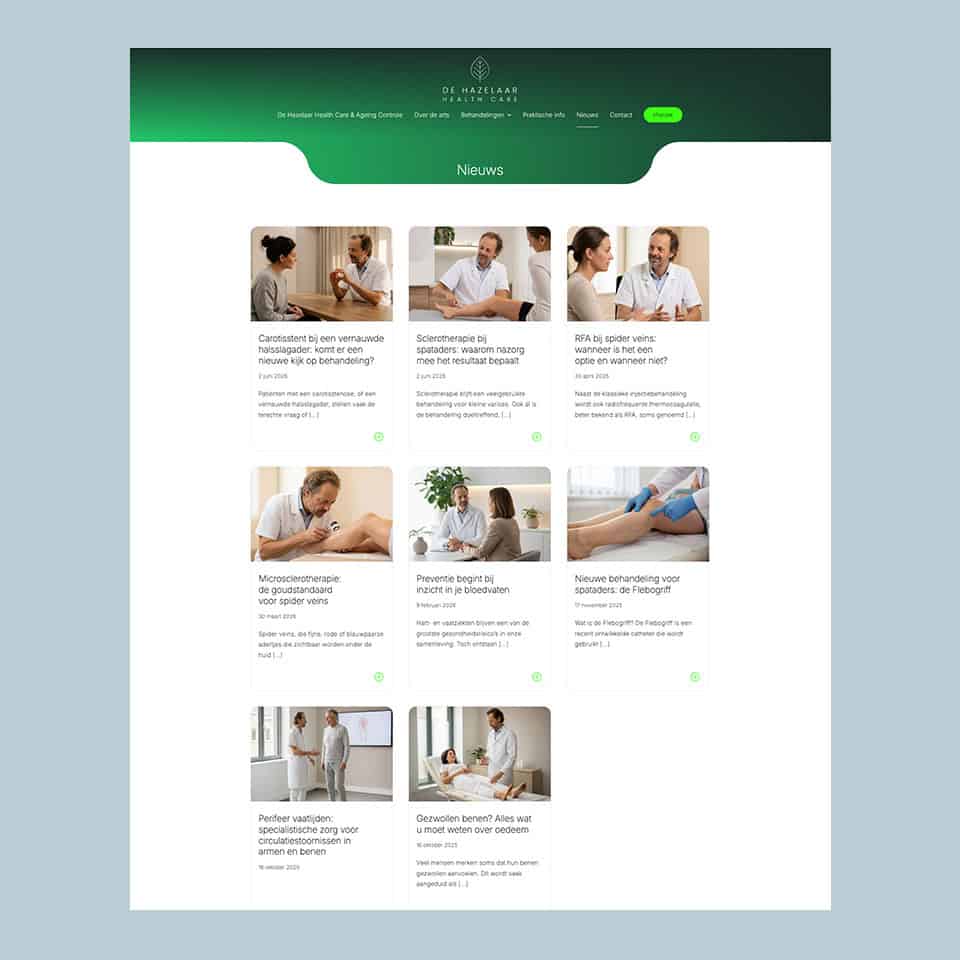
De Hazelaar Health Care is a specialized practice in vascular and thoracic surgery, active in three hospitals in the Antwerp region. LOFT 33 built a WordPress website featuring a blog, integrated online appointment management via Doctena, and Meta advertising campaigns to reach new patients.
Have a website created for a medical specialist: patients and referring physicians all in one place
A website for a vascular surgeon requires a different approach than a website for a family physician. Patients are looking for clear explanations and quick appointments. Referring physicians want to see in-depth medical information and a credible profile. De Hazelaar Health Care needed to serve both groups, offering vascular and thoracic surgery treatments at three hospitals in the Antwerp region.
LOFT 33 built a WordPress website for De Hazelaar Health Care featuring a site structure with two entry points, a blog, online appointment scheduling via Doctena, and Meta ad campaigns. Here’s a look at how the process unfolded and what results it yielded.
Who is De Hazelaar Health Care?
De Hazelaar Health Care is a specialized medical practice in Antwerp, led by Dr. Roderik Deleersnijder, a specialist in vascular and thoracic surgery. Together with Dr. Schoonjans, Dr. Thomas, and Dr. Wustenberghs, he treats patients with conditions of the blood vessels and the thoracic region.
The range of treatments is broad and technically specialized. On the arterial side: peripheral arterial disease, carotid stenosis, and aneurysms. On the venous side: varicose veins, thrombosis, lymphedema, and laser treatment. For thoracic surgery: lung tumors, collapsed lung, and pleural conditions. The practice is active in three hospitals: Diagnosecentrum Voorkempen in Zoersel, ZAS Augustinus in Antwerp, and AZ Voorkempen in Malle.
That broad, technically specialized profile is exactly what defines the digital challenge. On one hand, the website must be accessible to patients facing a vascular condition or thoracic problem for the first time. On the other hand, it must immediately make clear to referring GPs and other specialists which medical profile and expertise they are dealing with.
What was the challenge?
Two target groups, one website
Patients and referring physicians use a medical website in fundamentally different ways. A patient first reads general information about a condition, looks for reassurance, and assesses whether they’ve found the right place. A GP or specialist quickly scans for medical credibility, looking at the doctor’s profile and the technical depth of the treatment range.
A website that works for both target groups is not a compromise between two extremes. It is an architecture that offers the right information to every visitor at the right time.
Making a complex range of treatments clear
Three major areas of specialization, each with multiple specific conditions and treatment techniques: that’s a lot of information to present in an accessible way. Too much detail in the wrong place drives patients away. Too little detail in the wrong place fails to convince referring physicians.
Expanding online reach through advertisements
A specialized practice isn’t automatically visible to people facing a vascular problem for the first time. Many patients search Google or social media for information about their condition long before they have a referral from their GP. Reaching those people early, with the right information at the right time, requires more than just a good website.
How did LOFT 33 handle this?
Site structure based on two entry points
The De Hazelaar Health Care website is structured around two logical entry points that coexist without interfering with each other.
The first entry point is the treatment pages. These are built in three layers: the specialization domain (arterial vascular surgery, venous vascular surgery, thoracic surgery), the specific condition (peripheral arterial disease, carotid stenosis, varicose veins, lung tumors), and the treatment techniques per condition. This structure works for both target groups: a patient can look up their condition and find understandable information, while a referring physician can navigate directly to the medical depth.
The second entry point is the doctor’s profile. For a specialized practice, the person of the doctor is a central element of trust. The “About the doctor” page presents the medical profile, expertise, and the hospitals where the doctor is active, in a way that is relevant to both patients and fellow physicians.
WordPress with blog
LOFT 33 chose WordPress as the platform. The blog is a conscious choice for a specialized practice: medical content about specific conditions and treatment techniques strengthens the website’s SEO position for specialized searches, while simultaneously building medical authority with referring physicians who visit the website multiple times.
Integration with Doctena
Online appointment management via Doctena was integrated into the website on the homepage and on relevant treatment pages. This makes the threshold for a patient to book an appointment as low as possible.
Meta ad campaigns
LOFT 33 also guided the setup and management of Meta ad campaigns for De Hazelaar Health Care. These campaigns target people who encounter information about vascular conditions or thoracic problems via social media, leading them to the relevant treatment pages on the website.
For a specialized practice, this is an effective addition to organic findability: the target group is specific enough to target precisely, and the threshold to make an appointment is low if the website has already built trust.
GDPR-compliant setup
All contact forms and data-processing elements are configured to be GDPR-compliant. For a medical practice, the website indirectly processes health data via appointment requests and contact forms. LOFT 33 implements this technically correctly; the legal and policy-related implementation, such as a processing register or DPA agreements, is the responsibility of a qualified legal advisor or DPO.
What were the results?
The De Hazelaar Health Care website gives the practice a digital presence proportional to the medical expertise behind it. Patients find accessible, correct information about their condition and can book an appointment online. Referring physicians find a medical profile that radiates credibility and makes it clear what expertise they are dealing with.
The blog strengthens organic findability for specialized searches, allowing the practice to reach people who don’t have a referral yet but are actively searching for information about their condition.
The Meta ad campaigns further expand that reach to people who don’t know the practice yet but belong to the target group.
What does this mean for your practice?
The challenge faced by De Hazelaar Health Care—serving two target groups with one coherent digital presence—is recognizable to every specialized doctor or surgeon. Whether it’s orthopedics, cardiology, dermatology, or another specialization: the combination of patients seeking reassurance and fellow physicians assessing medical credibility requires a well-thought-out digital architecture.
A website that only appeals to patients misses out on referrals. A website that only focuses on medical authority creates a barrier for patients facing a condition for the first time. The right approach finds the balance.
What makes a website for a medical specialist different from one for a GP or group practice?
Having a website made for a medical specialist requires a specific approach in three areas compared to a more general medical practice website.
Medical depth as a credibility signal
A specialist is judged on technical expertise. The website must demonstrate that expertise, not just name it. This means treatment pages that are substantively correct and sufficiently detailed to convince a referring physician, combined with an accessible layer for patients without a medical background.
The doctor’s profile as a central element
In a specialized practice, the person of the doctor is the primary trust signal. Education, expertise, hospital affiliations, and publications are relevant information for both patients and referring colleagues. This information requires its own place in the website structure.
Targeted ads as a supplement to organic findability
A specialist has a more specific target group than a GP. This makes targeted ads on social media or search engines more efficient: the target group is precisely defined, and the message can directly align with the condition or the visitor’s search behavior.
Frequently asked questions about websites for medical specialists
LOFT 33 guides the entire process from analysis and site structure to development, content strategy, and launch. For medical practices, this also includes: GDPR-compliant configuration of all forms and data-processing elements, integration with external appointment systems, and a tone of voice that fits the practice’s specific target groups. After the launch, LOFT 33 can also take care of technical maintenance and expansions.
LOFT 33 works with WordPress for medical practices where the internal team wants to manage content independently, and with Joomla for more complex platforms with extensive user management, multilingualism, or deep custom integrations. The choice of platform depends on the specific needs of the practice and is discussed during the intake interview.
LOFT 33 configures all data-processing elements of the website correctly: forms with explicit consent, cookie management that meets GDPR requirements, and a setup where no health data is stored without the proper technical and organizational measures. For policy and legal matters, such as a processing register or DPA agreements, LOFT 33 refers you to a qualified legal advisor or DPO.
Yes. At De Hazelaar Health Care, LOFT 33 integrated the website with Doctena, allowing patients to book appointments directly online. The integration is featured on pages where visitors make decisions, such as the treatment pages. We’ll discuss which system you use during the intake interview.
They complement organic search visibility. For De Hazelaar, LOFT 33 set up targeted Meta campaigns to reach patients who weren’t yet searching for a practice. Whether this makes sense for you depends on the treatments you offer and your region.
That depends on the scope: the number of treatments, the target audiences, integrations such as an appointment scheduling system, and the amount of medical content. After the initial consultation, LOFT 33 will provide a realistic timeline for your project.
Yes. LOFT 33 handles the entire content strategy, including rewriting existing text or writing new pages. Medical content is written based on input from the practice, in a tone of voice that is accurate and accessible to patients without a medical background. The final review of medical information always rests with the doctors or specialists involved.
Discover more

10 November, 2026
Housing for Zero Energy: A Website for Low-Carbon Housing Construction
The Housing for Zero Energy website is a trilingual Joomla site that LOFT 33 built for a European project focused on low-carbon housing. LOFT 33 organized the online build tool, the features, the projects, and the news into a clear structure.
7 November, 2026
Concreet Architecten website: projects clearly showcased
The Concreet Architecten website is a WordPress site (Avada) that LOFT 33 built for an architecture firm in Heverlee. LOFT 33 organized the projects into three sections and added an FAQ, publications, and a team page.
17 October, 2026
FEREB website for Belgian concrete specialists
The FEREB website is a bilingual Joomla site that LOFT 33 built for the Belgian Federation of Concrete Repairers. LOFT 33 organized member lists, documents, news, and a member portal around three types of visitors.