The Doxis and Freeliner website consists of two interconnected sites for Doxis, a Belgian manufacturer of architectural lighting based in Genk. Doxis designs, manufactures, and assembles premium lighting fixtures there and supplies them to dealers in more than 20 countries.
LOFT 33 built a corporate website in Joomla featuring a blog and an online catalog with an advanced product search tool, as well as a separate product website with a product video for Freeliner, Doxis’s LED fixture for ceiling and pendant lighting.
Two websites for one lighting manufacturer
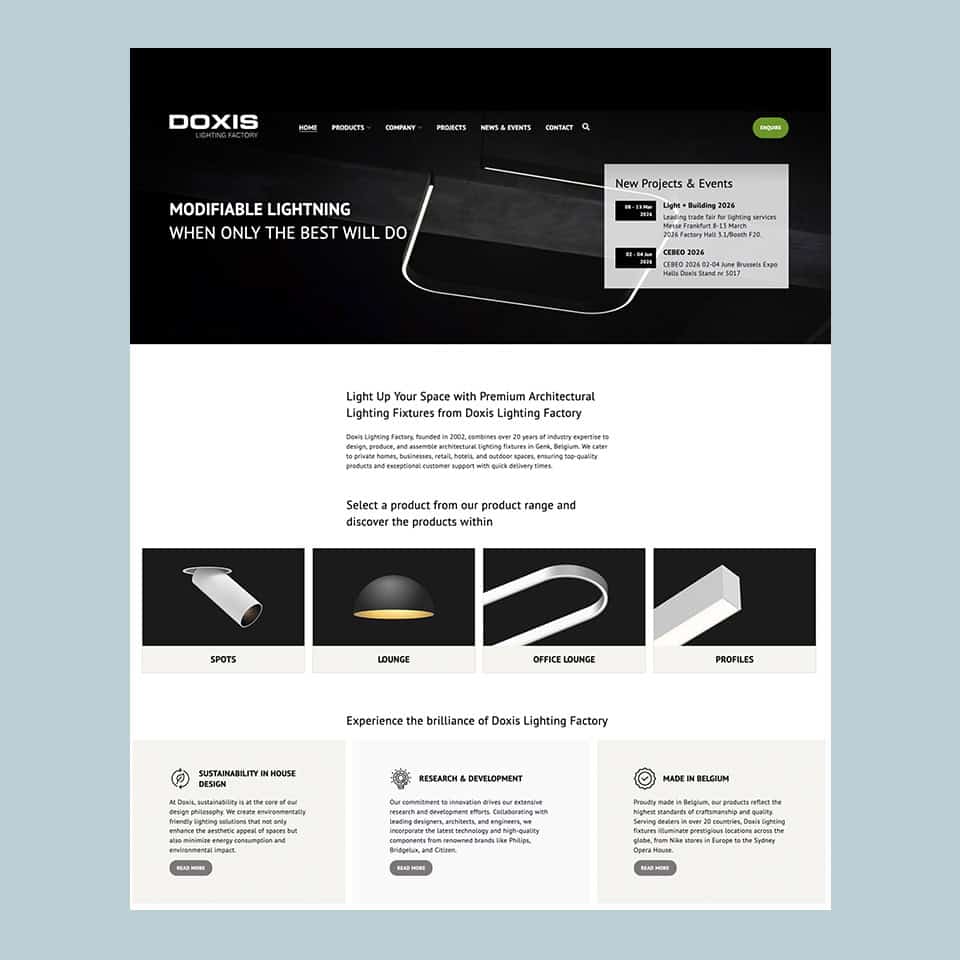
Doxis’s product line is divided into four categories: Spots, Lounge, Office Lounge, and Profiles. LOFT 33 built doxis.be to showcase the entire collection. For one fixture in the range—the Freeliner—a dedicated website was created, complete with its own story, video, and request process.
Who is Doxis?
Doxis is a Belgian manufacturer of architectural lighting fixtures, founded in 2002 and based in Genk. On its website, the company refers to itself as the Doxis Lighting Factory: design, production, and assembly all take place in Genk, and the products bear the “Made in Belgium” label. The fixtures are installed in homes, businesses, stores, hotels, and outdoor spaces. Among its references, Doxis lists Nike stores in Europe and the Sydney Opera House.
Freeliner is an LED fixture by Doxis designed for residential and office spaces, available in four shapes: Round, Square, Paperclip, and Linear. The aluminum profile contains up to 70% recycled material, and Doxis offers a five-year warranty.
The challenge: making a technical product line discoverable
When selecting lighting for a project, people rarely start with a product name. An architect, installer, or lighting designer needs a mounting method, a light output, a color temperature, and a dimming system—and looks for the fixture that fits those requirements. A manufacturer’s website must support that search, even when each category consists of multiple models.
In addition, Freeliner requested its own dedicated space. A product line with four shapes, nine colors, and acoustic options tells its story better on its own site than as a product listing among the rest of the range.
LOFT 33’s Approach
LOFT 33 followed a consistent sequence from analysis to development.
Analysis and Target Audience Definition
First, we determined who the sites are intended for. Freeliner’s brochure template outlines the visitor profiles Doxis aims to reach: private individuals, architects, electricians and installers, electrical and lighting wholesalers, retailers, and lighting designers. These profiles determine what each page should address.
Structure and Management Logic
On doxis.be, the company story is separate from the product lineup. Under “Company,” visitors will find the Doxis Lighting Factory, sustainability, research and development, “Made in Belgium,” and the company’s mission. Under “Products” is the product range; under “Projects” are completed projects; there is also a “Get Inspired” section featuring applications in homes, stores, and commercial spaces; and a blog for news and events.
UX and Content Architecture
There are two ways to choose a product. Those who prefer to be guided can select one of the four categories in the Guided Product Overview. Those who already know the technical requirements can use the Advanced Search.
Development and Custom Programming
LOFT 33 built a real-time catalog module in Joomla for the product finder. The filters are organized according to how professionals make their selections: product category, mounting type, lumen range, tilt range, diameter range for recessed spotlights, color temperature, dimming system, adjustability, and driver location, with a button to reset the filters. Those who want a complete overview can request the catalog via “Request our catalog.”
On freeliner.be, LOFT 33 integrated a product video into the introduction section, between the story and the presentation of the designs. This is followed by the dimensions, technical specifications, colors, and acoustic options, and the page concludes with a call-to-action for a phone quote, a contact form, and a brochure request.
The result
On doxis.be, visitors can find the right light fixture in two ways: through the categories or using the filters in the advanced search. Quotation and catalog requests follow set paths (Enquire, Contact, and Request our catalog), and the project and inspiration materials support the story of a manufacturer that supplies products to more than 20 countries.
On freeliner.be, each product is presented with a cohesive narrative: video, shapes, features, colors, acoustics, and a direct request form. The site is designed to allow an architect or installer to decide in a single visit whether to request a quote or a brochure.
What does this mean for your business?
If you offer a technical product line that your customers compare based on specific features, your website should support that comparison. This requires a product finder with the filters your customers actually use, a structure that clearly distinguishes between your company’s story and your products, and an assessment for each product line to determine whether it warrants its own website.
A platform like this aligns with our approach to custom websites and platforms. If you’re unsure whether to choose a website, an online store, or an online catalog, read on to find out which solution is right for your business.
Potential Concerns with a Catalog Site
A catalog with filters seems like a lot of work to maintain. That’s why we determine in advance how a new product is added and which properties control a filter. Adding a new fixture then does not change the structure of the site.
Does a product line really need its own website? Not always. It’s worthwhile when the line has its own target audience and its own story, as with Freeliner. For the other products, a spot in the catalog is sufficient. We’ll discuss this decision with you before development begins.
We operate internationally. The Doxis and Freeliner websites are in English. A multilingual setup is possible, as with EuroMedix, which was built to be multilingual.
Frequently Asked Questions About Websites for Lighting Manufacturers
LOFT 33 builds platforms where technical products can be found, compared, and requested. We start with the way your customers make their choices and build the structure, filters, and management system around that. Want to know what that means for your product line? Discover the process
The price depends on the scope of the product line, the number of filters, and the management logic. That’s why we provide a quote after a consultation, as part of our approach to custom websites and platforms. Schedule a no-obligation consultation, and we’ll provide you with a proposal tailored to your product line.
Post the video early on, but after a brief introduction. On freeliner.be, the video appears between the description of the fixture and the presentation of the designs: this way, visitors know what they’re seeing and are then provided with the technical details. Keep the video file size small so the page continues to load quickly.
Let visitors specify who they are when they submit a request. Freeliner’s brochure form asks whether the requester is a private individual, architect, installer, wholesaler, retailer, or lighting designer. This way, the sales team knows right away who to contact for each request and what that person needs.
Yes, Joomla is well-suited for platforms with many product features and sophisticated management logic. LOFT 33 builds a custom catalog module so that the filters, product data, and management functions work seamlessly together. For smaller websites without a catalog, WordPress may be a better choice. We’ll recommend the best option after a brief discussion about your product range.
The filters are based on your customers’ selection criteria. For architectural lighting, these include mounting method, lumen range, color temperature, dimming system, and driver location. Limit the number of filters to those that a professional actually uses, and make sure each filter is easy to understand without an explanation.
That depends on the target audience and the brand’s story. A standalone website works well if the brand has its own message and visitors need to follow a single, clear path. That’s why Freeliner got its own website featuring video, graphics, colors, and a request form. Products that don’t need their own story are better suited for the catalog.
A lighting website must provide quick answers to technical questions. Visitors want to browse the product range by category, filter by features such as mounting, lumens, and color temperature, and request a catalog or quote. In addition, project case studies, client references, and sustainability information build the trust that an architect or wholesaler needs to make a decision.
Discover more

10 November, 2026
Housing for Zero Energy: A Website for Low-Carbon Housing Construction
The Housing for Zero Energy website is a trilingual Joomla site that LOFT 33 built for a European project focused on low-carbon housing. LOFT 33 organized the online build tool, the features, the projects, and the news into a clear structure.
7 November, 2026
Concreet Architecten website: projects clearly showcased
The Concreet Architecten website is a WordPress site (Avada) that LOFT 33 built for an architecture firm in Heverlee. LOFT 33 organized the projects into three sections and added an FAQ, publications, and a team page.
19 October, 2026
.be, .com, or .eu: Which domain extension should you choose for your business?
Should you choose a .be, .com, or .eu domain name? The best domain extension depends on your target audience, market, brand, and future plans. In this article, you’ll learn about the differences, the impact on SEO, and when it makes sense to register multiple domain names.