The Housing for Zero Energy website is the online platform for H4.0E, a European Interreg project that offers an open-source design and construction platform for affordable, low-carbon homes. Ten partners are collaborating on the project.
LOFT 33 built an informative website in Joomla in English, Dutch, and German, featuring a blog, articles, an overview of the projects, and a link to the online build tool.
A European project that needs to explain itself
A European project has partners in various countries, a technical tool, and a message that visitors need to understand quickly. The website had to explain in just a few lines what the platform does and where it’s used. LOFT 33 built the website around that brief.
Who is Housing for Zero Energy?
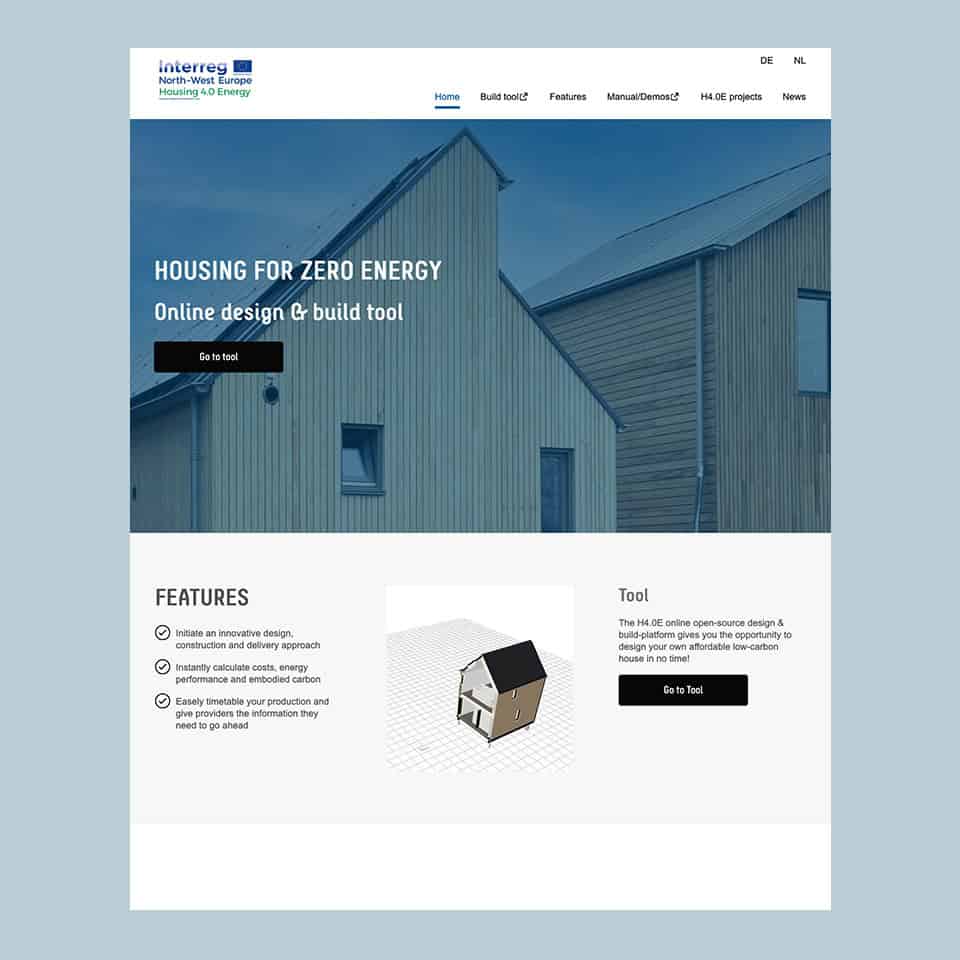
Housing for Zero Energy, also known as H4.0E or Housing 4.0 Energy, is an online platform that lets you design an affordable, low-carbon home. The website states that its goal is to introduce a new approach to designing, building, and delivering homes, with immediate calculations of costs, energy performance, and embodied carbon, as well as planning for production and the information providers need. The project is a collaboration involving, among others, 3CEA, Flemish Brabant, TU Delft, the Province of Antwerp, Open Systems Lab, Tecnolec, Thoma, South West College, the Municipality of Almere, and Elfitech.
The challenge: a tool and a project all in one website
The platform has two sides. There’s the build tool, which allows a user to select a location, draw a lot, and customize a design. And there’s the project itself, featuring partners, completed projects, and news. A visitor had to understand which of the two they needed.
On top of that, the project spans multiple countries. The website had to be available in three languages.
LOFT 33’s Approach
LOFT 33 followed a consistent sequence from analysis to development.
Analysis and Scope Definition
We first determined what a visitor wants to do: try out the tool, see what the project has to offer, or get to know the partners. Those three actions determined the structure.
Structure and Management Logic
The main menu includes Home, Build Tool, Features, Manual/Demos, H4.0E Projects, and News. The homepage explains how it works in three steps: choosing a location and drawing the building lot, selecting and customizing a design, and starting to build. Partner logos highlight the collaboration.
UX and Content Architecture
The features describe what the platform offers: a new approach to design, construction, and delivery, as well as real-time calculations and production planning. The “H4.0E Projects” section showcases four completed projects: WikiHouse in Almere, Holz 100 in Baden-Württemberg, Mobble in Huldenberg, and 3CEA in Kilkenny and Carlow. Each project has its own page.
Development and Custom Programming
LOFT 33 built the website using Joomla, with a language selector for English, Dutch, and German. The website directs visitors to the online build tool and to a user guide with demos.
The result
Anyone who visits the Housing for Zero Energy website will understand what the platform does within seconds and can immediately click through to the build tool. The completed projects demonstrate that the approach works in various countries. News and training courses keep the website up to date.
The trilingual design ensures that partners and interested parties can read the information in English, Dutch, or German.
What does this mean for your organization?
If your organization is leading a European project, a consortium, or an innovation partnership, the same choices apply. Explain in a few sentences what the project delivers, provide a clear introduction to the tool or result, and showcase the partners and projects as evidence.
This type of project falls under our approach for custom websites and platforms. You can see an international B2B approach in the Camco Technologies case study. To learn why Joomla is well-suited for multilingual projects, read our article on Joomla for comprehensive websites and portals.
Potential concerns regarding a website for a European project
Our project has many partners. This is an asset if the website displays them clearly. A logo block on the homepage and a dedicated page for the partnership make the list easy to manage.
Our tool is hosted on a different website. That’s fine. The website explains what the tool does and provides a link to it, so visitors understand what they’ll be using.
We work in three languages. A multilingual setup is easy to manage when all languages follow the same pages and menus. We set up the management system so that a change in one language doesn’t break the others.
Frequently Asked Questions About Websites for European Projects
LOFT 33 builds websites for European projects and consortia that want to clearly explain a tool or outcome. We start with your visitors’ questions and build the structure, languages, and project pages around them. Would you like to know what this could mean for your project? Discover the process
Establish a regular news section and a consistent management process so that news, training programs, and results are posted online quickly. In the case of a European project, funding sometimes ends before the project is no longer relevant. Agree in advance on who will continue to manage the website and how long it will remain online.
Yes, Joomla provides good support for multilingual websites, with a language switcher and separate menus for each language. LOFT 33 uses it for institutional and international clients. For a small website with just a few pages, WordPress may be sufficient. We recommend making a decision after discussing your project.
Build the structure once and have the English, Dutch, and German versions follow the same pages. Include a clear language selector at the top of each page. This way, the menus and pages remain the same, and partners in every country can read the same information in their own language.
Give each project its own page with a name, location, and a brief description, and group them under a single section. “Housing for Zero Energy” showcases four projects in four countries. This demonstrates that the approach works beyond a single region and provides partners with a platform to showcase their results.
Give the tool its own spot in the main menu and explain on the homepage what visitors will find there. Housing for Zero Energy uses a menu item called “Build Tool” and a brief, three-step explanation. This way, visitors know what they’re doing before they click through.
A website like this should explain the project’s objective in a few sentences, showcase the partners, and demonstrate the results. It should also include a link to the tool or product, news about the project’s progress, and a language selection option for the countries where the project is active.
Discover more

7 November, 2026
Concreet Architecten website: projects clearly showcased
The Concreet Architecten website is a WordPress site (Avada) that LOFT 33 built for an architecture firm in Heverlee. LOFT 33 organized the projects into three sections and added an FAQ, publications, and a team page.
19 October, 2026
.be, .com, or .eu: Which domain extension should you choose for your business?
Should you choose a .be, .com, or .eu domain name? The best domain extension depends on your target audience, market, brand, and future plans. In this article, you’ll learn about the differences, the impact on SEO, and when it makes sense to register multiple domain names.
17 October, 2026
FEREB website for Belgian concrete specialists
The FEREB website is a bilingual Joomla site that LOFT 33 built for the Belgian Federation of Concrete Repairers. LOFT 33 organized member lists, documents, news, and a member portal around three types of visitors.