Google is increasingly providing direct answers to search queries, without users having to click through. Which websites appear in these results and which don’t depends on new criteria that traditional SEO didn’t take into account. Here’s what has changed and what your website needs now.
What Google Has Changed
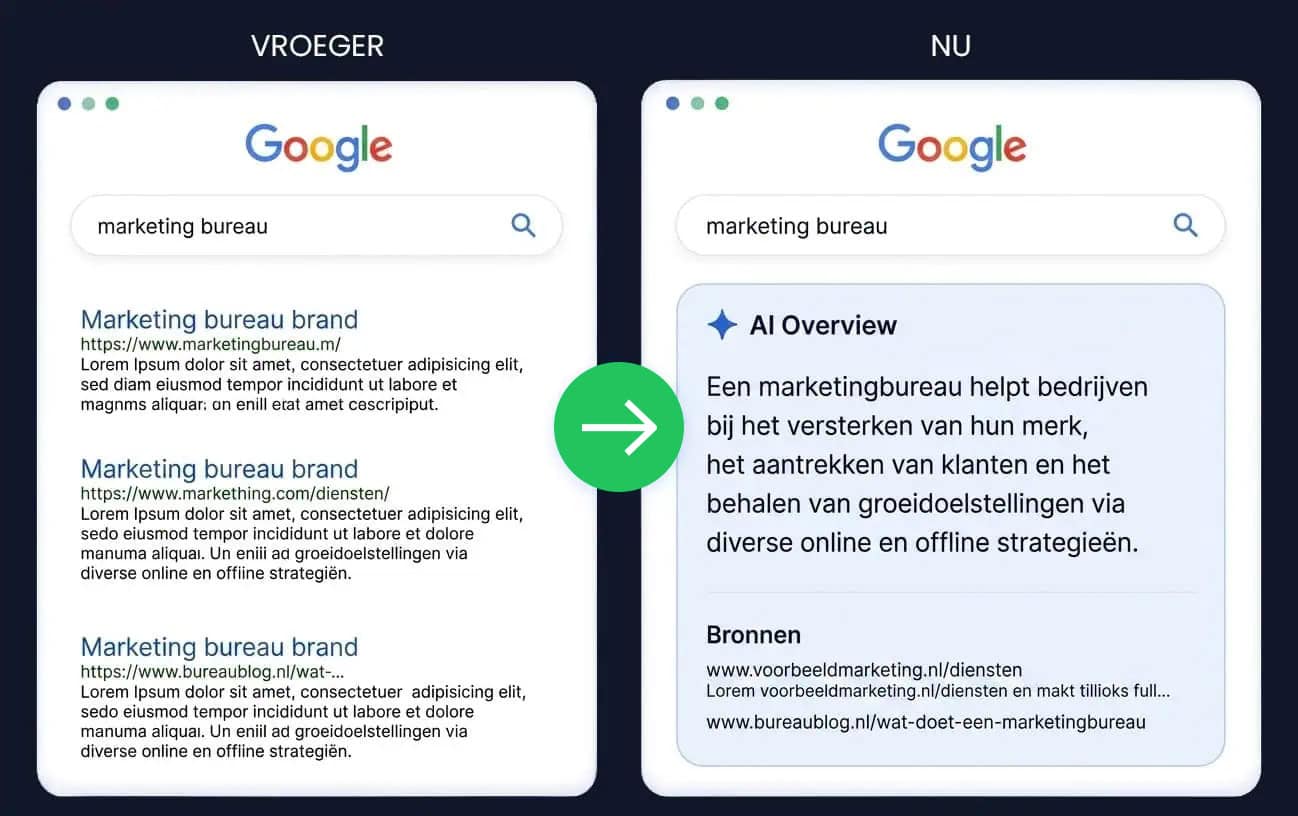
In recent months, Google has implemented a major shift in how it displays search results. At the heart of this change: Google uses artificial intelligence to answer search queries directly, even before a user clicks on anything.
This is called AI Overviews. You’ll recognize it when you search on Google and see a summarized answer at the top of the page—not a list of links, but a response generated on the spot by Google based on multiple sources.
At the same time, Google is introducing a new “AI Mode”: a conversational search experience that allows users to ask follow-up questions, similar to how ChatGPT works. This makes Google not just a search engine, but an AI assistant that understands, explores, and answers your question.
The impact on websites is tangible. Those who used to rank first or second in search results are sometimes seeing their traffic decline—not because their ranking has changed, but because a growing number of searchers are getting their answer right at the top of the page and aren’t clicking any further. We call this “zero-click search”: the user gets their answer without ever landing on a website.
From Vines to Being Cited
This is the most important mindset shift that every website administrator and SME business owner needs to make.
Traditional SEO revolved around one question: Does my website rank high enough in the search results? The new reality adds a second question that has become at least as important: Does Google use my website as a source for its AI answers?
That second question is fundamentally different. A website can easily rank third in the traditional search results but still never be cited in an AI Overview. And a website ranked sixth may very well be cited, because its content is structured in a way that AI systems can read, understand, and trust.
Google itself calls this “AI citation optimization”: the art of not only ranking well, but also being cited. This requires a website to do things differently than traditional SEO.
What Google Rewards Now
At the same time, Google has published new guidelines on what it rewards and what it penalizes. The focus is on five specific elements.
E-E-A-T: experience, expertise, authority, and trustworthiness.
E-E-A-T stands for Experience, Expertise, Authoritativeness, and Trustworthiness. These are the criteria Google uses to determine whether a website is an authoritative source. Specifically, this means: Who writes the content? What is his or her background? Are sources cited? And is the information demonstrably accurate? A website that publishes anonymous or generic content without a clear author or expertise scores low in these areas.
Original content with real insights.
Google rewards content that adds value to what already exists. A page that simply rewrites what ten other websites have already said is considered less relevant than a page that includes your own experiences, case studies, or viewpoints. For small and medium-sized businesses, this means: write based on what you actually know and do, not on what you think Google wants to read.
Structured data and schema markup.
Structured data is a technical addition to a website’s code that helps Google understand exactly what a page describes. Who are you, what do you do, where do you operate, what are your hours of operation, and what questions does this page answer? This information is not only included in the text but also in a standardized technical language that search engines can read directly. Websites without structured data lack an important signal that AI systems use to select sources.
Clear question-and-answer structure.
AI systems look for pages that ask a question and answer it directly and completely. A page that doesn’t get to the point until after three introductory paragraphs falls short in this process. FAQ sections, question-form headings, and answers that follow immediately after the question: these aren’t just useful for human readers, but also essential for how AI systems process information.
No manipulation of AI results.
Google has released new spam guidelines specifically targeting what it calls “GEO spam”: attempts to manipulate AI results by writing content intended solely to deceive AI systems rather than inform human readers. Sites caught engaging in these practices risk lower rankings or complete removal from search results. Google’s message is clear: write for people, and optimize for AI as an additional layer—not the other way around.
What this means in practical terms for your website
The shift Google is undergoing translates into a concrete checklist of elements that a modern SME website needs. Below are the most important ones, explained without technical jargon.
Less focus on keywords, more on topical authority.
Topical authority means that your website is viewed as an authoritative source on a specific topic, not just on a single keyword. In the past, it was enough to write a page that included the right keyword. Today, Google rewards websites that cover a topic comprehensively: multiple pages that together form a coherent and in-depth whole. For an SME website, this means: don’t just write about what you do, but also about the questions, concerns, and context related to it.
Conversational content.
AI systems process language differently than traditional search engines. They understand context, nuance, and intent. Content written in natural, spoken language—the way you would explain something to a customer—aligns better with how these systems work than content filled with repetitive keywords. Write the way you speak, but polished.
FAQ sections and structured data.
Every page that describes a service or topic should include an FAQ section with questions your customers actually ask. Those questions and answers should also be technically marked up using FAQ schema markup—a line of code that tells Google this is a question-and-answer section. This significantly increases the chances of being included in AI Overviews.
A fast, mobile-friendly website.
This was already important, but it’s becoming even more so now. AI systems crawl websites faster and more frequently than they used to. A slow website or one that doesn’t work well on mobile devices sends a negative signal that carries more weight in the new reality than it did in the old one.
Internal link structure and topic clusters.
A good internal linking structure, in which pages link to one another in a logical way, helps Google understand how your website is organized and which pages are related. Topic clusters are groups of pages that, together, comprehensively cover a single topic. A central page on “web design for SMEs” with several in-depth pages on subtopics is more effective than ten separate pages with no internal links.
llms.txt.
This is a new file that websites can add to guide AI systems in reading the site. Think of it as the equivalent of robots.txt, the file that search engines have been using for years to understand which pages they’re allowed to index. llms.txt does something similar, but specifically for large language models such as ChatGPT, Claude, and Gemini: it tells those systems which pages are most relevant, how the website is structured, and which information takes priority. For most SME websites, this is still an optional step, but early adopters are already gaining an advantage by implementing it.
Markdown versions of content.
Markdown is a simple markup language that structures content without complex HTML. AI systems can read Markdown quickly and efficiently. In addition to their regular web pages, some websites also offer a Markdown version of key content—a file that AI systems can access directly without having to process the entire web page. This is an advanced step, but it’s relevant for companies that want their expertise to be as visible as possible to AI agents.
Accessibility.
Accessibility—the extent to which a website is accessible to people with disabilities—is a quality indicator that Google is giving increasing weight to. An accessible website has clear heading structures, alternative text for images, and a logical, readable layout. These are exactly the same elements that help AI systems understand a website correctly.
The biggest change in a single sentence
Rankings are becoming less important than being cited.
A website that ranks fifth but is cited in an AI Overview is more visible than a website that ranks second but is never used as a source. The battle for attention is shifting from the rankings to source attribution.
For SMEs that invest in the right changes now, this is an opportunity. In most sectors and regions, competition in this area is still limited. Those who adapt their websites to the new criteria now will build a position that will be harder to match later on.
What a Strong SEO Foundation Means Today
The new requirements don’t replace the fundamentals of traditional SEO; they build on them. Anyone who wants to prepare their website for the new reality now needs to work on two levels at the same time.
The first layer is the classic foundation that still matters today: a technically sound website, fast loading times, a properly structured sitemap, high-quality content, and a healthy backlink profile. Anyone who falls short here won’t make it to the second layer.
The second layer is what’s new: structured data, FAQ sections, conversational content, topical authority, internal link structure such as topic clusters, and, where relevant, llms.txt and Markdown versions of key pages.
LOFT 33 brings both layers together into a single process. For new websites, these elements are built into the development process as standard. For existing websites, LOFT 33 offers a targeted audit that assesses the website’s current status and identifies which changes will have the greatest impact.
“My website already ranks well on Google—should I be worried?”
Maybe not right away. But it’s a question worth asking.
A website that ranks well in traditional search results today has a strong foundation. That foundation also helps in the new reality. However, ranking well in traditional search results does not guarantee that your website will also be cited in AI Overviews or AI Mode responses.
The way to find out is to take a look. Search Google for the questions your customers are asking. Do you appear in the AI Overview at the top of the page? Are you cited as a source? If the answer is no, you’ve got some work to do—even if your website is technically ranked well.
LOFT 33 can conduct that analysis and translate it into concrete priorities.
What LOFT 33 does
LOFT 33 brings both layers together into a single process. For new websites, these elements are built into the development process as standard. For existing websites, LOFT 33 offers a targeted audit that assesses the website’s current status and identifies which changes will have the greatest impact.
Frequently Asked Questions About the Google AI Update
A Google AI Overview is an AI-generated response that appears at the top of the search results page. Google compiles this answer based on multiple websites it considers reliable sources. The user gets an answer immediately without having to click through. Which websites are used as sources depends on the quality, structure, and reliability of the content.
Zero-click search means that a user gets their answer right on the search results page itself, without clicking through to a website. For websites that rely on organic traffic, this can lead to fewer visitors, even if their ranking in the traditional search results remains the same. The solution is to ensure that your website is cited as a source in those direct answers, so that you remain visible even without a click.
E-E-A-T stands for Experience, Expertise, Authoritativeness, and Trustworthiness. These are the criteria Google uses to assess whether a website is an authoritative source. For an SME website, this means, in practical terms: publish content based on genuine expertise, identify the author, back up claims with sources, and ensure that the information is up-to-date and accurate.
Structured data is a technical addition to a website’s code that helps search engines and AI systems understand what a page is about. It’s essentially a translation of your content into a language that machines can read directly. For SME websites, structured data is no longer an optional extra—it’s a basic requirement for anyone who wants to appear in AI Overviews and other AI-driven search results.
llms.txt is a new file that websites can add to help large language models, such as ChatGPT, Claude, and Gemini, navigate the site. It tells these systems which pages are most relevant and how the website is structured. For most SME websites, this is still an advanced step, but companies that want to maximize their online authority can start using it right away.
A first test: search Google for questions your customers are asking and see if your website appears in the AI Overview at the top of the page. A second test: open ChatGPT or Perplexity and ask a question about your industry and region. If you don’t appear, or if competitors who are objectively less established do, then your website probably isn’t set up for the new criteria. LOFT 33 can provide a concrete analysis of where your website stands.
Discover more

19 October, 2026
.be, .com, or .eu: Which domain extension should you choose for your business?
Should you choose a .be, .com, or .eu domain name? The best domain extension depends on your target audience, market, brand, and future plans. In this article, you’ll learn about the differences, the impact on SEO, and when it makes sense to register multiple domain names.
15 October, 2026
How do you optimize Google Maps for your business?
A complete and up-to-date Google Business Profile helps customers find, contact, and visit your business. Find out how to align your business information, categories, photos, reviews, and website to sustainably boost your local visibility on Google Maps. Discover how to optimize Google Maps and your Google Business Profile for more relevant local connections online.

12 October, 2026
Digitizing Trust: The mHealth Belgium Website
LOFT 33 built the mHealth Belgium website, the official Belgian platform for the validation of mobile health apps. Institutional and clear.