The Qaelum website showcases software developed by a Leuven-based company that helps hospitals and radiology practices monitor radiation doses and the quality of medical imaging. Qaelum was founded in 2011 as a spin-off of UZ Leuven and has offices in Leuven and New York.
LOFT 33 built an informative website in Joomla in English, French, German, and Spanish, bringing together eight solutions, news, events, partners, and customer stories.
A software offering that requires explanation
Qaelum started with a quality control tool for mammography screening and built a product family around it. A website for a company like this must both provide a technical explanation of what the software does and help a director or quality manager make a decision. LOFT 33 translated this into a structure in which each product has its own page.
Who is Qaelum?
Qaelum is a medical imaging software company founded in 2011 by Hilde Bosmans, Raymond Oyen, and Jurgen Jacobs. The company is a spin-off of UZ Leuven and states that it develops its software to make healthcare safer. Its headquarters are in Leuven, and it has also had an office in New York since 2016. According to the website, the software is in use in more than 16 countries.
The product portfolio consists of eight solutions. DOSE manages patients’ radiation doses across locations, devices, and vendors. The Foqal series covers CT Repeat, Contrast, MRI, Compliance, Forms, and Radiography, while Mammo focuses on mammography. The website states that Qaelum is certified to ISO 13485:2016 and ISO 27001:2022.
The challenge: a diverse target audience and a comprehensive offering
The Dose page mentions a broad group of users: radiologists, technicians, medical physicists, physicians, and administrators who make investment decisions. Each of them is looking for something different. A medical physicist wants to know which dose parameters the system monitors, a radiologist wants to know how alerts work, and a manager wants to know what benefits the system delivers.
In addition, Qaelum operates internationally and uses four languages. The website also needed to demonstrate that the software is reliable—through certifications, publications, and testimonials from hospitals—without resorting to marketing jargon.
LOFT 33’s Approach
LOFT 33 followed a consistent sequence from analysis to development.
Analysis and Scope Definition
We first identified the roles the website serves and the questions each role raises. This determines what should be included on a product page: what the software does, how it integrates, what benefits it provides, and where the evidence can be found.
Structure and Navigation Logic
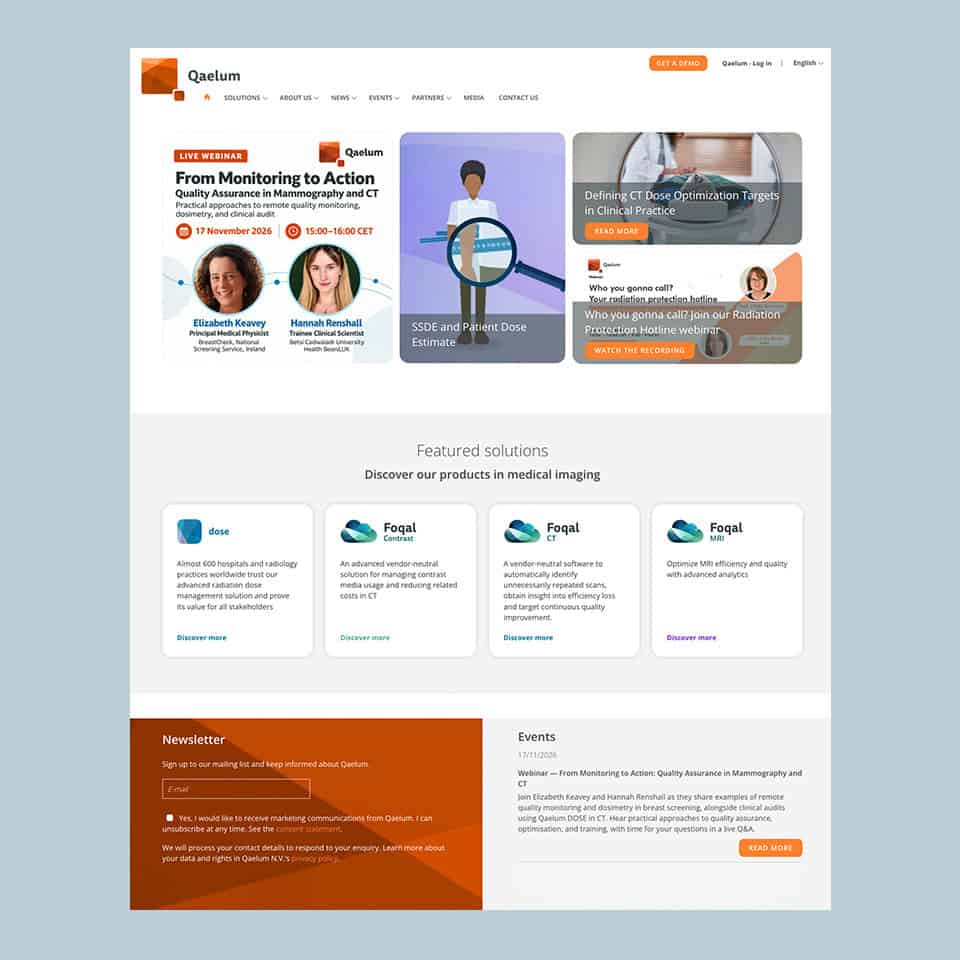
The main menu follows the decision-making process of a hospital: Solutions, About Us, News, Events, Partners, Media, and Contact. The eight products are listed under Solutions. The About Us section includes information about the company, the team, careers, professional organizations, and sustainability. The News section features news, customer stories, and press contacts.
UX and Content Architecture
The DOSE page begins with a brief summary and the “Request a Demo” button. Below that, tabs organize the content into sections such as “Description,” “Features,” “CMS,” “Publications,” and “Media,” allowing readers to jump to the relevant section without having to scroll. Videos, webinar recordings, and frequently asked questions are all on the same page. At the top, visitors will always find a button to request a demo and a button to log in.
Development and Custom Programming
LOFT 33 built the website using Joomla, with four language versions available side by side. The newsletter explicitly requests marketing consent and includes a CAPTCHA to ensure that subscriptions are valid and comply with privacy regulations.
The result
Visitors to the Qaelum website can find the product that meets their needs in just a few clicks, in their own language. Each solution has its own page. Website visitors can learn how the software works, watch videos and webinars, review scientific publications, and read about how a hospital like Asklepios Klinik Altona uses the software.
News, events, and partners have dedicated sections. This keeps the site up to date without changing its structure whenever a webinar, trade show, or new product is added.
What does this mean for your organization?
If your company offers software or equipment with multiple products and multiple user roles, the same approach applies. Give each product the same page layout, let visitors choose the language and user role they want to view the content in, and make evidence such as certifications, publications, and customer stories easy to find.
You can find a similar approach for international medical technology in the case studies of EuroMedix and CHARMcm. If you work directly in healthcare, check out our page on websites for medical practices. If you’re looking for greater visibility in the sector, read about digital marketing for the medical sector.
Potential concerns regarding a medical software website
Our product offerings are growing and evolving. This is normal for a product family. That’s why we use the same structure for every product, so that new solutions can be added without having to rebuild the structure.
Our software is not available in every country. This can be clearly stated on the product page, as Qaelum does. That way, visitors know right away what’s available in their country.
A medical website raises questions about regulations and privacy. LOFT 33 handles the technical implementation. For claims regarding medical devices and GDPR compliance, we refer clients to a qualified legal advisor or DPO to ensure that the content and technical design are aligned.
Frequently Asked Questions About Websites for Medical Software Companies
Assign a dedicated section in the menu to news, events, and customer stories. New items will then appear in the correct list without changing the structure. Also, don’t delete past events; instead, move them to a section for past events.
LOFT 33 builds websites for companies with technically complex products. We start with the roles and needs of your visitors and build the product structure, content, and evidence around them. Want to know what that could mean for your offerings? Discover the process
Yes, Joomla is well-suited for websites with a lot of structured content, multiple languages, and an extensive menu. LOFT 33 uses it for institutional and medical clients. For a smaller website with just a few pages, WordPress may be sufficient. We recommend making this decision after discussing your specific needs.
Build the structure once and have each language follow the same pages. That way, the products, tabs, and menus will remain the same, even if some translations are completed later. Add a clear language selector to every page, as Qaelum does in English, French, German, and Spanish.
Provide concrete evidence: quality certifications, scientific publications, and customer testimonials from hospitals and the organizations of which you are a member. Place that evidence close to the product description, not just on a separate page. Avoid superlatives that you cannot back up, and let visitors verify your claims for themselves.
Give each product the same structure: a short summary, a button to request a demo, and tabs for description, features, publications, and media. This way, visitors will find the same information in the same place on every page, and the website will remain manageable as new products are added.
A website like this needs to explain, in technical terms, what the software does while also convincing decision-makers. This requires a clear product structure, a demo request form, evidence such as certifications and customer stories, and a choice of language that suits the countries where the company operates. Keep the explanations concrete so that both a specialist and an executive can find what they’re looking for.
Discover more

10 November, 2026
Housing for Zero Energy: A Website for Low-Carbon Housing Construction
The Housing for Zero Energy website is a trilingual Joomla site that LOFT 33 built for a European project focused on low-carbon housing. LOFT 33 organized the online build tool, the features, the projects, and the news into a clear structure.
7 November, 2026
Concreet Architecten website: projects clearly showcased
The Concreet Architecten website is a WordPress site (Avada) that LOFT 33 built for an architecture firm in Heverlee. LOFT 33 organized the projects into three sections and added an FAQ, publications, and a team page.
19 October, 2026
.be, .com, or .eu: Which domain extension should you choose for your business?
Should you choose a .be, .com, or .eu domain name? The best domain extension depends on your target audience, market, brand, and future plans. In this article, you’ll learn about the differences, the impact on SEO, and when it makes sense to register multiple domain names.