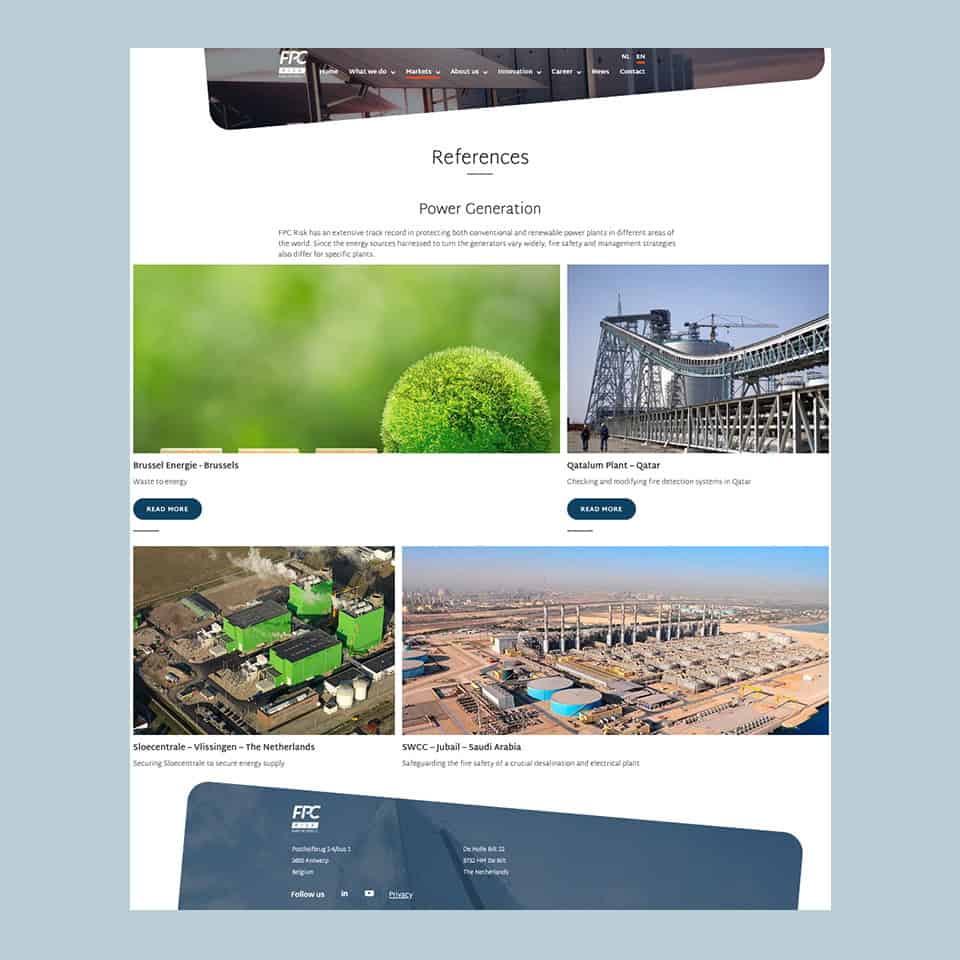
The FPC Risk website showcases a consulting firm specializing in fire risk and emergency management with offices in Antwerp and De Bilt. The company describes itself as a truly independent partner, with no financial ties to equipment manufacturers, installation companies, or insurers.
LOFT 33 built an informative website in Joomla in Dutch and English, featuring news, ten market pages, innovation tools, and a careers section.
A Consulting Firm That Must Prove Its Independence
A consulting firm sells trust. For FPC Risk, that means demonstrating that it is independent, that it has experience in the client’s industry, and that it offers concrete services and tools. LOFT 33 built the website around these three points.
Who is FPC Risk?
FPC Risk is a consulting firm specializing in fire risk and emergency management, founded in 1973 as the first independent fire prevention consulting firm in Europe. The company offers three services: Fire Risk Consulting, Fire Risk Engineering, and Emergency Management Services. According to its website, FPC Risk has been designing fire protection systems for over 45 years. It has offices in Antwerp and De Bilt.
The challenge: one firm serving ten sectors
FPC Risk operates in a wide range of sectors: oil and gas, petrochemicals and chemicals, pharmaceuticals and medical, hotels, offshore platforms, infrastructure, commercial centers and office buildings, power generation, manufacturing and logistics, and non-standard buildings. Each sector has its own risks, its own rules, and its own jargon.
In addition, the firm offers a wide range of innovative solutions—from simulations to a crisis dashboard—and is actively recruiting employees in Belgium and the Netherlands. The website needed to serve these diverse target audiences without diluting the message.
LOFT 33’s Approach
LOFT 33 followed a consistent sequence from analysis to development.
Analysis and Scope Definition
We first identified who visits the website: clients looking for a sector and risk profile, partners, and candidates looking for a job. This led to a distinction between the offerings for clients and the content for candidates.
Structure and Navigation Logic
The main menu includes What We Do, Markets, About Us, Innovation, Careers, News, and Contact. The three services are listed under What We Do. Under “Markets,” each of the ten sectors has its own page. Under “Innovation,” there are eight products and services: CFD, Sprinkler Design, Remote FR Screening, Crisis Dashboard, Quick Scan, Pre-incident Plan, Evac Modeller, and Risk Evaluator, in addition to the FPC Risk Academy, the Innovation Groups, and IMFSE.
UX and Content Architecture
A client in the pharmaceutical sector is directed straight to the page for pharmacy and medical. Anyone looking for a specific tool can find it under “Innovation.” Job candidates have their own section with job descriptions, such as fire risk engineer, emergency management analyst, and commissioning officer, as well as a page detailing a day in the life of a fire risk engineer.
Development and Custom Programming
LOFT 33 built the website using Joomla, featuring a language switcher between Dutch and English, a news section, and a careers section with separate job listing pages for Belgium and the Netherlands.
The result
Visitors to the FPC Risk website can quickly find what they’re looking for by browsing services, markets, or innovation. Each sector has its own page, allowing clients to find content relevant to their specific context. News articles on topics such as fire safety in historic buildings and in the oil and gas sector showcase the firm’s expertise.
The careers section gives candidates a clear picture of the positions and how the firm operates, allowing it to recruit directly without intermediaries.
What does this mean for your organization?
If your agency works with clients from multiple sectors, it’s worth setting up a structure with a separate page for each sector. Showcase your independence and experience, make your tools and innovations easy to find, and create space for recruitment without disrupting your client offerings.
This type of project falls under our approach to custom websites and platforms. You can see an international B2B approach in the Camco Technologies case study. You can find an overview of what we build on the page about websites and online stores.
Potential concerns regarding a website for a consulting firm
We work across many industries. This is an asset if the website allows for it. A separate page for each industry lets each client recognize their own context, without making the firm seem fragmented.
Our tools are technical. Give each tool a short, easy-to-understand page explaining what it does and who it’s for. Those who want more information can then find the details.
We also recruit through the website. A dedicated careers section with job descriptions works alongside the client offerings without the two interfering with each other.
Frequently Asked Questions About Websites for Risk Management Consulting Firms
LOFT 33 builds websites for consulting firms that want to clearly showcase their independence, experience, and tools. We start with your clients and build the structure, industry pages, and careers section around them. Curious about what this could mean for your firm? Discover the process
Create a separate section for recruitment with job descriptions and stories from colleagues, and keep the client offerings separate in the main menu. FPC Risk has an extensive Career section with job openings for Belgium and the Netherlands. This way, every visitor can quickly find what they’re looking for. It prevents candidates and clients from getting in each other’s way.
Yes, Joomla provides good support for multilingual websites, with a language switcher and separate menus for each language. LOFT 33 uses it for institutional and international clients. For a small website with just a few pages, WordPress may be sufficient. We recommend making a decision after a consultation.
Give each tool its own page with a brief description, its application, and contact information. FPC Risk groups eight products and services under “Innovation,” in addition to an academy and innovation groups. This way, a customer can find the tool without having to browse through the entire portfolio.
Give each sector its own page under a single “Markets” section, with the same structure: the risks, the approach, and an example. This way, every client can recognize their own context, and the menu remains easy to navigate, even if a new sector is added. This also improves searchability by sector.
State this explicitly and explain what it means. FPC Risk states that it has no financial ties to manufacturers, installers, or insurers. Post this explanation on the homepage and on the services page so that customers understand why the advice is objective.
A website like this should clearly explain the services, showcase industry experience, and build trust. It should also include news that demonstrates expertise, a clear way to get in touch, and possibly a careers section. Independence and experience call for concrete examples, not empty promises. This is how an agency builds credibility step by step.
Discover more

10 November, 2026
Housing for Zero Energy: A Website for Low-Carbon Housing Construction
The Housing for Zero Energy website is a trilingual Joomla site that LOFT 33 built for a European project focused on low-carbon housing. LOFT 33 organized the online build tool, the features, the projects, and the news into a clear structure.
7 November, 2026
Concreet Architecten website: projects clearly showcased
The Concreet Architecten website is a WordPress site (Avada) that LOFT 33 built for an architecture firm in Heverlee. LOFT 33 organized the projects into three sections and added an FAQ, publications, and a team page.
19 October, 2026
.be, .com, or .eu: Which domain extension should you choose for your business?
Should you choose a .be, .com, or .eu domain name? The best domain extension depends on your target audience, market, brand, and future plans. In this article, you’ll learn about the differences, the impact on SEO, and when it makes sense to register multiple domain names.