The IO-Link Group Belgium website is the online platform for a group of major suppliers of IO-Link solutions, united under Agoria. IO-Link is a manufacturer-independent communication standard for sensors and actuators, and has been an international standard under IEC 61131-9 since 2013.
LOFT 33 built a bilingual website in Joomla in Dutch and French, featuring a blog, news, downloads, and a members-only page.
Explaining a technical standard to the entire industry
IO-Link is not a product but a standard endorsed by many suppliers. A website for such a collective must explain the standard to engineers and decision-makers, while also presenting all members on an equal footing. LOFT 33 built the website around these two objectives.
Who is IO-Link Group Belgium?
IO-Link Group Belgium is a collective of suppliers of IO-Link solutions. It was founded with the goal of promoting the technology across all Belgian industries. Its members include Balluff, Beckhoff, Festo, IFM Electronic, Pepperl+Fuchs, Pilz, SICK, Siemens, Turck Multiprox, Vega, and WAGO. According to the website, IO-Link reduces planning, installation, and wiring costs thanks to universally compatible inputs and outputs.
The challenge: one message for many suppliers
Anyone representing a collective of competitors must not favor any single member. The website had to explain the standard in a neutral manner, display all member logos equally, and provide space for news from various members.
In addition, the explanation must appeal to two types of readers: those who are not yet familiar with IO-Link and are looking for an overview, and those who are already familiar with the technology and want access to products or documentation.
The LOFT 33 approach
LOFT 33 followed a consistent process, from analysis to development.
Analysis and scoping
We first identified the questions a visitor might have: What is IO-Link? What are its benefits? Who is behind it? And where can I find more documentation? Those four questions formed the basis of the main menu.
Structure and management logic
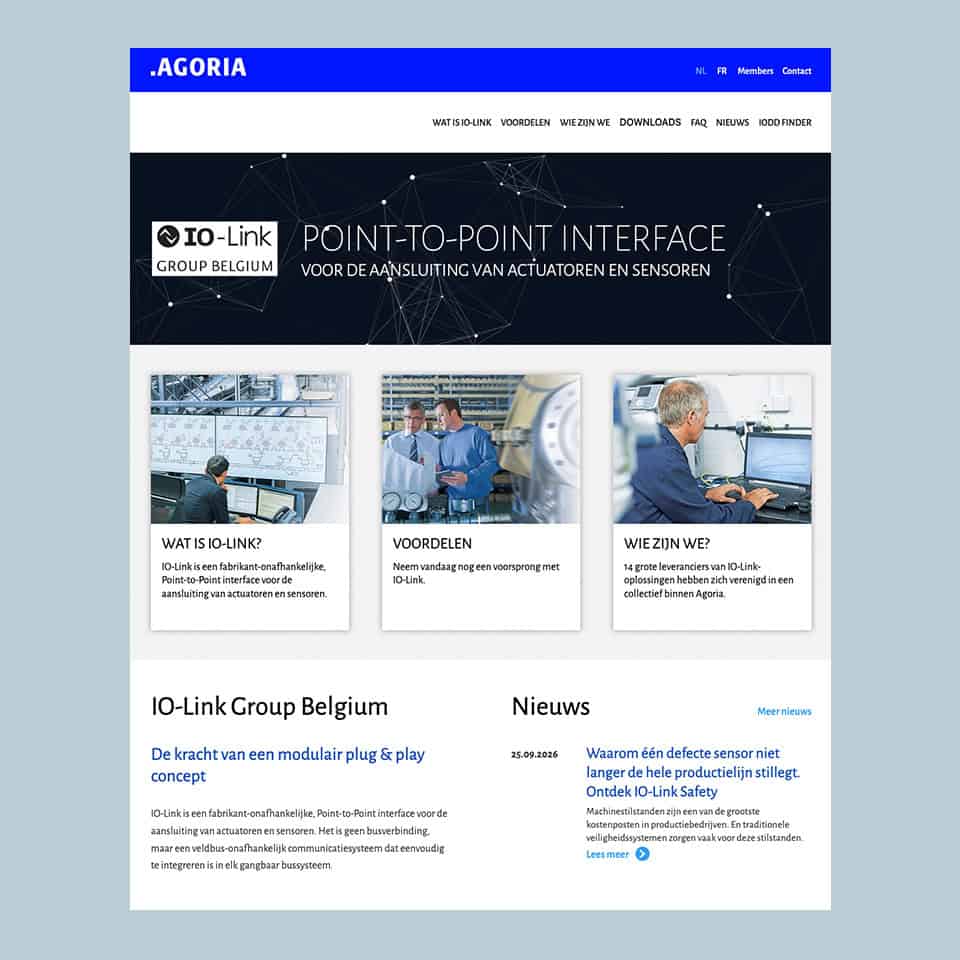
The main menu includes “What is IO-Link,” “Benefits,” “About Us,” “Downloads,” “FAQ,” “News,” and a link to the IODD Finder. The top bar includes language selection, the members’ page, and Contact. The homepage displays a brief explanation, the three core sections, the latest news, events, and the members’ logos.
UX and content architecture
The explanation progresses from general to specific: first, what IO-Link is; then, its benefits; and finally, who makes up the consortium. Downloads, such as presentations, have their own page, and the IODD Finder links to the global tool for device descriptions.
Development and custom programming
LOFT 33 built the website using Joomla, featuring a language switcher between Dutch and French, a news feed with dates and summaries, and a members-only page.
The result
Visitors to the IO-Link Group Belgium website can learn about the standard, its benefits, and its members in just a few clicks. The news section highlights current applications, such as IO-Link Safety and new masters and gateways from members. Presentations and a link to the IODD Finder direct professionals to the relevant documentation.
The member logos show at a glance just how many renowned suppliers support the standard.
What does this mean for your organization?
If your organization represents a standard, a label, or a business consortium, the same considerations apply. Explain what it is and what benefits it offers before showcasing your members, give all members equal visibility, and ensure that documentation is easy to find.
This type of project falls under our approach to custom websites and platforms. You can read about a similar project for a federation in the Synergrid case study. An international B2B approach is featured in the Camco Technologies case study.
Potential Concerns Regarding a Website for an Industrial Collective
Our members are competitors. That’s why we’re designing the structure to be neutral: the same space and the same size for every member, with news published on a per-contribution basis. This way, no member feels left out.
Our standard is technical. That’s not a problem. We explain the standard in layers: first, a short, easy-to-understand version, followed by technical documentation for those who want to delve deeper.
We work in two languages. A bilingual setup is easy to manage when both languages follow the same pages and menus. We set up the management system so that a change in one language does not break the other.
Frequently Asked Questions About Websites for Industrial Partnerships
Place the link in a fixed, visible location in the menu and clearly state that the visitor is leaving the website. IO-Link Group Belgium includes a menu item that links to the IODD Finder and the global download page. This way, a professional can find the tool without having to search for it.
Yes, Joomla provides good support for multilingual websites, with a language switcher and separate menus for each language. LOFT 33 uses it for institutional and industrial clients. For a small website with just a few pages, WordPress may be sufficient. We recommend making a decision after discussing your content with us.
Publish news as separate articles with a date and summary, and give each article its own page. Cite the source of the news item. This keeps the news overview organized and allows visitors to easily click through to the topic that interests them. It also improves discoverability on Google.
Use a single logo block on the homepage where each member is given the same amount of space, and a members’ page with the same layout for each member. Sort alphabetically, not by importance. This way, the collective demonstrates unity, and the website remains fair to all members. This prevents disputes among members.
Take a layered approach. Start with a single page that explains, in plain language, what the standard is and what benefits it offers, and then refer readers to the technical documentation. IO-Link Group Belgium separates the explanation, the benefits, and the downloads so that each reader can proceed at their own level.
A website like this should explain the collective’s purpose, present its members as equals, and publish the latest news. It should also include documentation, such as presentations, and a contact page. For a technical standard, this should be supplemented by an explanation of the benefits for the industry.
LOFT 33 builds websites for organizations and federations that want to clearly explain a technical topic. We start with your visitors’ questions and build the structure, the explanations, and the members-only page around them. Curious about what this could mean for your organization? Discover the process
Discover more

10 November, 2026
Housing for Zero Energy: A Website for Low-Carbon Housing Construction
The Housing for Zero Energy website is a trilingual Joomla site that LOFT 33 built for a European project focused on low-carbon housing. LOFT 33 organized the online build tool, the features, the projects, and the news into a clear structure.
7 November, 2026
Concreet Architecten website: projects clearly showcased
The Concreet Architecten website is a WordPress site (Avada) that LOFT 33 built for an architecture firm in Heverlee. LOFT 33 organized the projects into three sections and added an FAQ, publications, and a team page.
19 October, 2026
.be, .com, or .eu: Which domain extension should you choose for your business?
Should you choose a .be, .com, or .eu domain name? The best domain extension depends on your target audience, market, brand, and future plans. In this article, you’ll learn about the differences, the impact on SEO, and when it makes sense to register multiple domain names.